
Why Tokenized Funds Are the Next ETF Moment
Financial markets occasionally experience structural innovations that permanently reshape how capital is invested and distributed. The introduction of exchange-traded funds (ETFs) in the early 1990s was one such moment. ETFs transformed asset management by combining diversification, liquidity, and low-cost distribution into a single instrument.
Today, tokenized funds have the potential to trigger a similar shift — but on a global, digital infrastructure built on blockchain.
While ETFs digitized the trading of funds, tokenization digitizes the entire lifecycle of asset ownership.
The ETF Revolution: What Actually Changed
Before ETFs, investing in diversified funds typically required purchasing mutual funds through banks or brokers. These funds had several structural limitations:
- Settlement times of several days
- Limited trading windows (often once per day NAV pricing)
- Geographic distribution barriers
- Significant operational overhead
The launch of the first major ETF, SPDR S&P 500 ETF Trust in 1993, fundamentally changed this model.
ETFs introduced three critical improvements:
- Intraday liquidity – investors could trade funds like stocks
- Lower costs – fewer intermediaries and automated portfolio replication
- Broad accessibility – available to retail and institutional investors globally
The result was explosive growth. ETFs have grown into a market exceeding $10 trillion in assets under management globally.
But despite this success, ETFs still operate on legacy financial infrastructure.
Tokenized Funds: A Structural Upgrade
Tokenized funds represent a deeper transformation than ETFs because they rebuild the entire financial operating system.
Instead of issuing shares through centralized registries and custodians, ownership is represented by blockchain tokens governed by smart contracts.
This allows the fund lifecycle to become programmable.
Key improvements include:
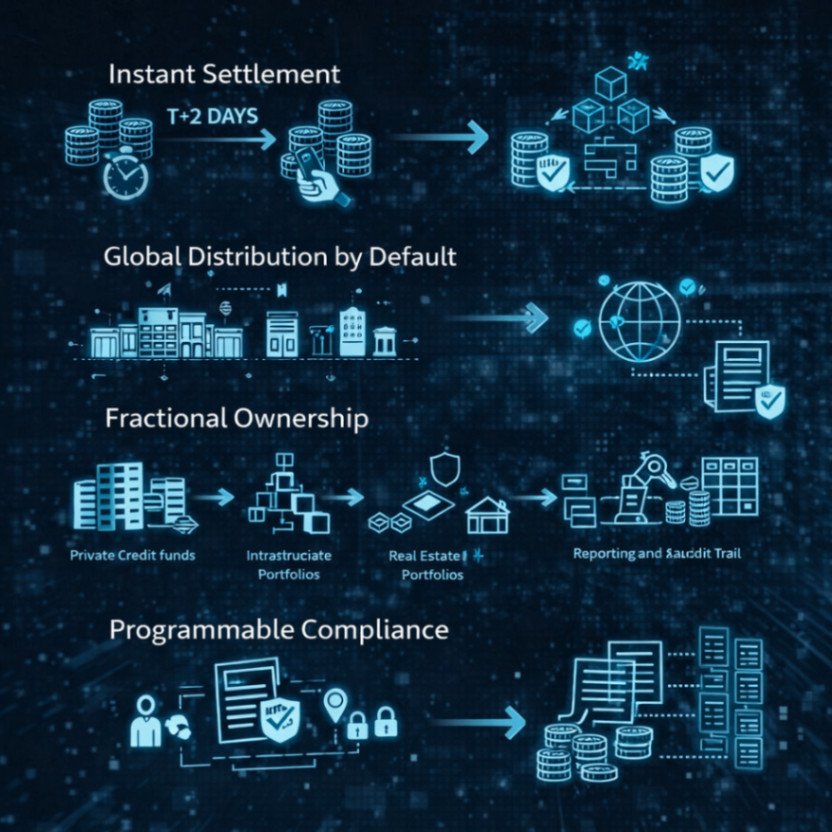
1. Instant Settlement
Traditional fund settlements may take T+2 days or longer depending on the jurisdiction.
Tokenized funds can settle within minutes or seconds, significantly reducing counterparty risk and capital lockups.
2. Global Distribution by Default
Traditional funds require complex regulatory arrangements and distribution partnerships in each jurisdiction.
Tokenized funds can onboard investors globally through digital identity verification and compliance rules embedded into smart contracts.
This creates the possibility of borderless capital formation.
3. Fractional Ownership
Blockchain infrastructure allows assets to be divided into extremely small ownership units.
This enables investment products that were previously inaccessible to most investors, such as:
- private credit funds
- infrastructure funds
- venture capital portfolios
- real estate portfolios
Fractionalization dramatically expands the potential investor base.
4. Programmable Compliance
One of the most powerful capabilities of tokenized funds is compliance automation.
Smart contracts can enforce regulatory restrictions automatically, including:
- investor accreditation requirements
- jurisdictional restrictions
- transfer limitations
- lockup periods
This reduces administrative overhead while ensuring regulatory compliance.
5. Automated Operations
Tokenized fund infrastructure can automate many operational tasks that previously required multiple service providers.
Examples include:
- dividend or yield distribution
- investor registry management
- subscription and redemption processing
- reporting and audit trails
This dramatically reduces operational costs.
The Distribution Breakthrough
One of the biggest barriers in traditional asset management is distribution.
Launching a fund is one challenge — getting investors to access it is another.
Tokenized infrastructure creates direct-to-investor distribution channels through digital investment platforms.
Asset managers can launch branded investment portals where investors:
- complete onboarding
- subscribe to funds
- track performance
- receive distributions
This model removes many layers of traditional financial distribution.
The Institutional Shift Is Already Starting
Major financial institutions have already begun exploring tokenized funds and real-world assets.
Examples include:
- BlackRock launching tokenized money market funds
- Franklin Templeton issuing blockchain-recorded treasury funds
- JPMorgan Chase experimenting with tokenized collateral and settlement systems
These early experiments indicate that tokenization is moving from concept to institutional infrastructure.
The Coming Market Expansion
The global asset management industry manages more than $100 trillion across public and private markets.
If even a small percentage of these assets migrate to tokenized infrastructure, the resulting market could rival the growth trajectory of ETFs.
But unlike ETFs, tokenized funds can represent far more than public equities.
They can include:
- private markets
- infrastructure projects
- credit instruments
- structured products
- real-world assets (RWAs)
This dramatically expands the investable universe.
Why This Moment Matters
The ETF revolution simplified trading funds.
The tokenization revolution simplifies creating and distributing funds.
This means asset managers no longer need to build massive operational infrastructure to launch new investment products.
Modern tokenization platforms now provide:
- issuance infrastructure
- compliance systems
- investor onboarding
- payment processing
- custody and wallet management
In effect, the financial industry is moving toward programmable capital markets.
Conclusion
The success of ETFs showed how powerful financial innovation can be when it reduces friction and expands access.
Tokenized funds go even further.
They digitize ownership, automate compliance, reduce operational complexity, and open global distribution channels.
In the same way ETFs unlocked a new era of accessible investing, tokenized funds may unlock a new era of programmable finance.
For asset managers, this means one thing: The next generation of funds will not just be traded electronically.
They will be issued directly on-chain.